
Rumi's Wedding Night:
Divine Poetry & Music of the Soul
First Congregational Church of Los Angeles
540 South Commonwealth Avenue Los Angeles, CA 90020
December 14th, 2025
Come join us for devotional music, sacred movement prayer, life-transforming stories and poetry in celebration of Rumi’s Sheb e Arus (Wedding Night).
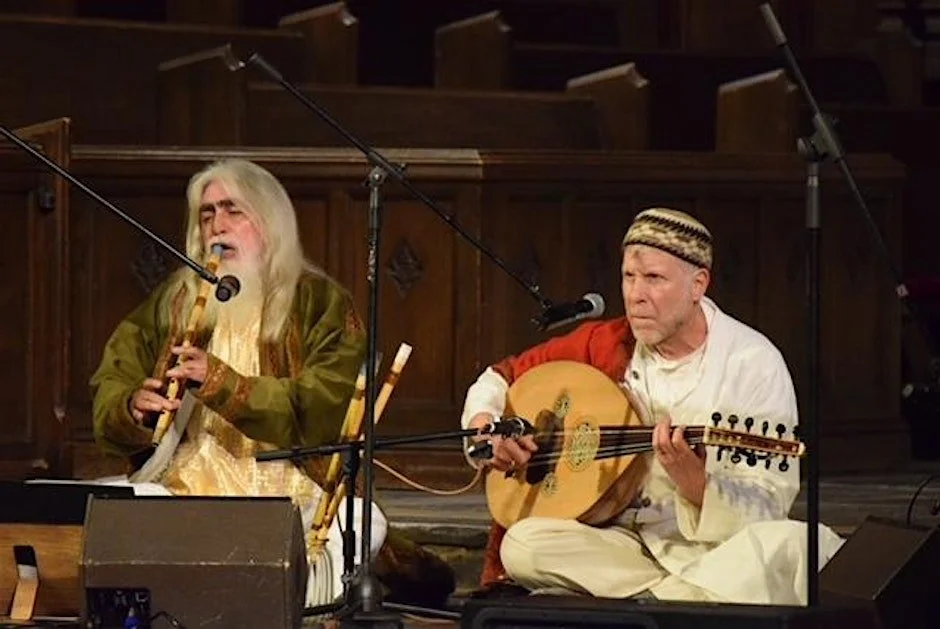
Yuval Ron Ensemble Featuring
Sufi master musician Khawaja Ehrari - ney and voice
Elham Delavari - whirling
Hamed Habibpour - santur, daf, and rabab
Housain Ehrari - percussion
Aziz Mahjoob - harmonium
Yuval Ron - artistic director, oud, and voice
Learn More about Yuval Ron at https://yuvalronmusic.com/
This program is supported, in part, by the Los Angeles County Board of Supervisors through the Department of Arts and Culture.
-
There are two pivotal moments in the life of the poet and mystic Jalāl al-Dīn Rūmī: The first is when he encountered the great spiritual presence of the wandering dervish Shams who became his greatest inspiration and closest companion. The second is when Shams disappeared from his life.
Until Shams appeared, Rumi had lived a fairly orthodox life as a preacher, scholar, and Islamic jurist, but in the presence of this wild holy man Rumi entered into a state of sacred communion. Their four years of companionship was a transformative time for Rumi, but the biggest change, his most celebrated spiritual transformation, came only when Shams suddenly disappeared. At this loss Rumi entered a deep period of grieving, desperately looking for Shams everywhere.
The story goes that he heard a rumor Shams was seen in Damascus, so Rumi traveled there to find him. While in the gold market, he heard the voice of his friend reciting the Zikr emanating from the smith’s delicate hammering. “La ilaha illallah”, there is no god but God. When he turned to find the voice he heard it all around him, and as he continued to turn a great love bloomed inside him. Rumi wrote:
Why should I seek?
I am the same as he.
His essence speaks through me.
I have been looking for myself!
It is only at this point in Rumi’s life that he began his seminal work, creating the poetry for which he is most well-known today.
We don’t talk about the destructive portion of the spiritual cycle enough, the necessary other half of creativity that gives way to new life, how loss and grief were the doors Rumi had to walk through to achieve both his spiritual and creative potential. American video artist Sherrie Rabinowitz said, “Artists need to create at the same scale that society has the capacity to destroy.” Notice the balanced nature of that statement. No more and no less, no dismissal of the need to destroy, but a recognition that the scales between creation and destruction must remain even.
Rumi wrote about the spiritual necessity of suffering and loss a great deal. He writes about the yearning fire, the burning crucible, the ash that fertilizes the soil. Rumi’s poetry was born out of unimaginable loss, a spiritual awakening that grew out of grief over his beloved companion. My wife (the interfaith minister and psychotherapist Cynthia Siadat) has taught me modern psychologists might call this Post-Traumatic Growth. It is a concept in contemporary psychology that is a positive transformation stemming from a traumatic experience. This internal change is often spiritual in nature, opening up new possibilities and a greater sense of purpose, meaning and a feeling of connection to something larger than oneself.
I have admired Rumi’s openhearted poetry my entire life, and for many years strived to create something so breathlessly honest and connected. It was only while writing this essay that I began to understand what it took for Rumi to have the spiritual awakening he did. I was sitting at the dining table next to my son and wife as I was writing when I had the sudden realization – it’s not worth it. I don’t care what promises of revelation lie on the other side. Looking at my family, the people I love the most, my siblings, my spouse, my child, I started to understand the loss Rumi suffered and realized I would give up all spiritual ambition if it meant the perpetual safety and well-being of those I love.
But here’s the thing: there are no such guarantees and we have to embrace emotional risks in order to fully live our lives. It can be too easy to try avoiding such pain and minimizing our losses by living life small, resisting connection, love, purpose, growth. Yes, it means we’ll lose more, hurt more, maybe even break, but what we see in Rumi’s story, and in similar stories shared by other spiritual masters, is that sometimes our life has to break in order for us to build something new from the shattered pieces.
I’m not suggesting we seek out grief and loss – quite the opposite; I suggest we completely embrace life. I believe part of our spiritual work, our spiritual responsibility, is to keep our hearts open to the world and to each other. I think this is why Sufi practices include so much music, dancing, and poetry. The arts open us in this way, expanding our sense of self and making room to let more of the world in.
Without such a practice at the center of our work we run the risk of shutting out the world when loss finds us. And loss will find us. We will know immense grief and suffering and it will be all the greater the more we have opened ourselves up. But, if we have risked such pain, on the other side of grief may lie mystery, an expansive state known only to those who have pried themselves open in the presence of devastating loss.
If you are in the midst of grieving, which I know can feel lonely and isolated, I hope this gathering may offer some measure of comfort and be a place to open yourself up again, even for a moment. If that’s not you right now then let us use this as an opportunity to practice widening the door and welcoming more of ourselves, the divine presence, and one another into the secret place inside us.