
Lithic Breathing
with Julia Edith Rigby
The Sanctuary
First Congregational Church of Los Angeles
540 South Commonwealth Avenue Los Angeles, CA 90020
Sunday, September 27th
A sonic journey through sea caves and pipe organs, exploring ritual, breath, resonance, deep time, and the hidden sounds of our planet.
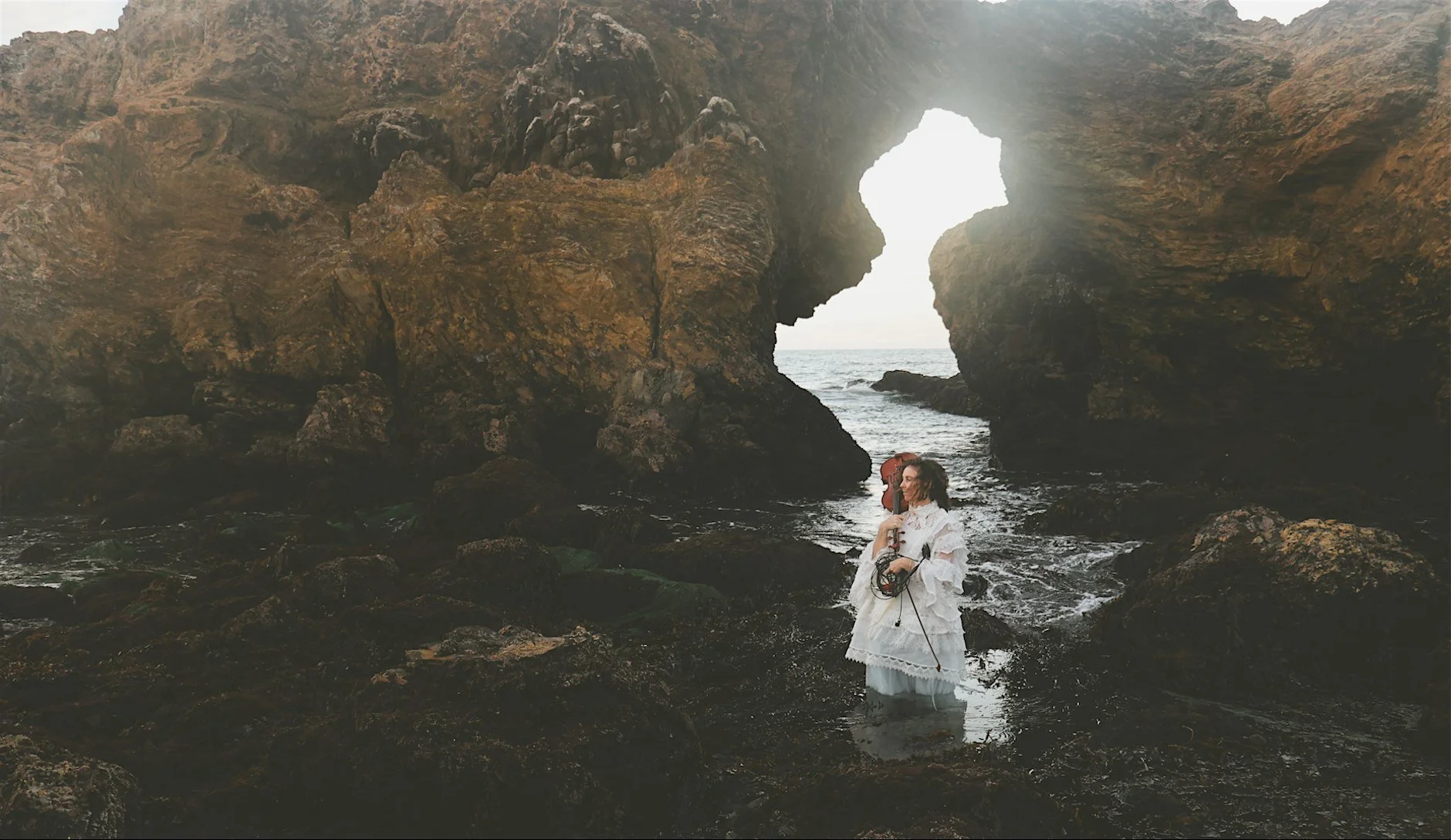
Resonance Collective presents Lithic Breathing - A concert work for pipe organ, viola, voice, field recordings, and live electronics, exploring the unexpected connections between sea caves and pipe organs—and how both can expand and entangle our thinking about ritual and breath, listening and resonance, deep time and sense of place.
Julia Edith Rigby performs on The Great Organs at First Congregational Church, creating immersive soundscapes inspired by ancient landscapes and opening our ears to subsonic listening, planetary histories, and infrasonic worlds.
-
I’ve always loved big questions rooted in poetic expression, abstract concepts with counterintuitive answers, ones best expressed through experience and art rather than rational dialectic. So, when Julia first reached out about this performance, I was intrigued by both the breadth and depth of the questions she was asking in her proposal. In some ways it seemed like more of a philosophical inquiry than a show, and, I have to admit, I wasn’t sure how such an interrogation would result in performance let alone in a satisfying musical experience; I am, afterall, in the business of producing concerts.
Don’t worry, the work is beautiful and the sonic landscapes stand on their own with textures and melodies that mimic the captivating, diverse minutiae in the sounds of nature. It is the scale of the inquiry, however, that deepens the sense of beauty, just as the stars turn from a dazzling light show into a spiritually humbling experience when we begin contemplating the vastness of space. Julia is asking big questions, questions about our perceptions and how they inform our understanding of who we are and the relationship we have to the world around us.
What happens when we give our attention to materials and timescales that are far bigger and older than ourselves, to resonances that make our bones hum?
Breath is the connective tissue of this concert, breath and resonance. How the water and wind moves through sea caves, creating a song like howl that echo the pumped air through the pipes of the massive organ at First Congregational Church. How both seem to mimic our own organic breath, the invisible but constant cyclical undulation at the center of our lives.
It is not just breath, however, but breath as a vehicle for resonance – resonance as a means of putting two objects in dialogue, in relationship. And we are always relating, creating, emitting, and absorbing vibration, then in turn creating and emitting new vibrations to be absorbed. That’s physics, but it’s not music. Music doesn’t exist out there in the world, it exists because of us and is filtered through our bodies as well as our minds before it takes coherent shape. The mind itself, our experiences and expectations, our state of being, our questions and considerations, are the final part of the sound chain and all indelible parts of what music fundamentally is. Without interpretation and memory we only experience a collection of sounds.
another of Julia’s questions:
How can geological listening help liberate our imaginations from the present moment, allowing us to speculate on what might have been, and what might be? To fever dream deep into our planet’s mercurial pasts and far forward into potential futures?
Let me tell you part of my fever dream: In these questions I hear the implication that deep listening, listening through our creative imagination, can radically alter perception away from our singular, linear perspective. By engaging in simultaneous listening, or what Jonathan Harvey calls the ambiguities of music, we can hear the multi-layered natures of a sound all at once and perhaps collapse the arrow of time into a kind of simultaneity we theorize about but do not experience. This is a listening where each sound exists unto itself and as a collection of memories, a listening across geological eras where we hear both an ancient and present moment together, a listening that expands the boundaries of our sense of self, entwining our identity with those around us to layer the perceptions of others onto our own, and perhaps even further towards the non-human, the inorganic. Or as Julia asks:
What is it like to hear the secret world of stone?
Perhaps these analogies and parallels are a stretch, perhaps this anthropomorphism of rocks and sea caves, this collapsing of time and perception is a step too far, a fanciful flight of imagination that veers into the realm of magical thinking. Certainly the world is wondrous enough and doesn’t need us to add additional layers of fantasy for it to already be fantastical. And perhaps such creative imagining is exactly what we need to realize a truth beyond rational knowing: that the world is more interconnected than we could possibly imagine.
Performers
Julia Edith Rigby
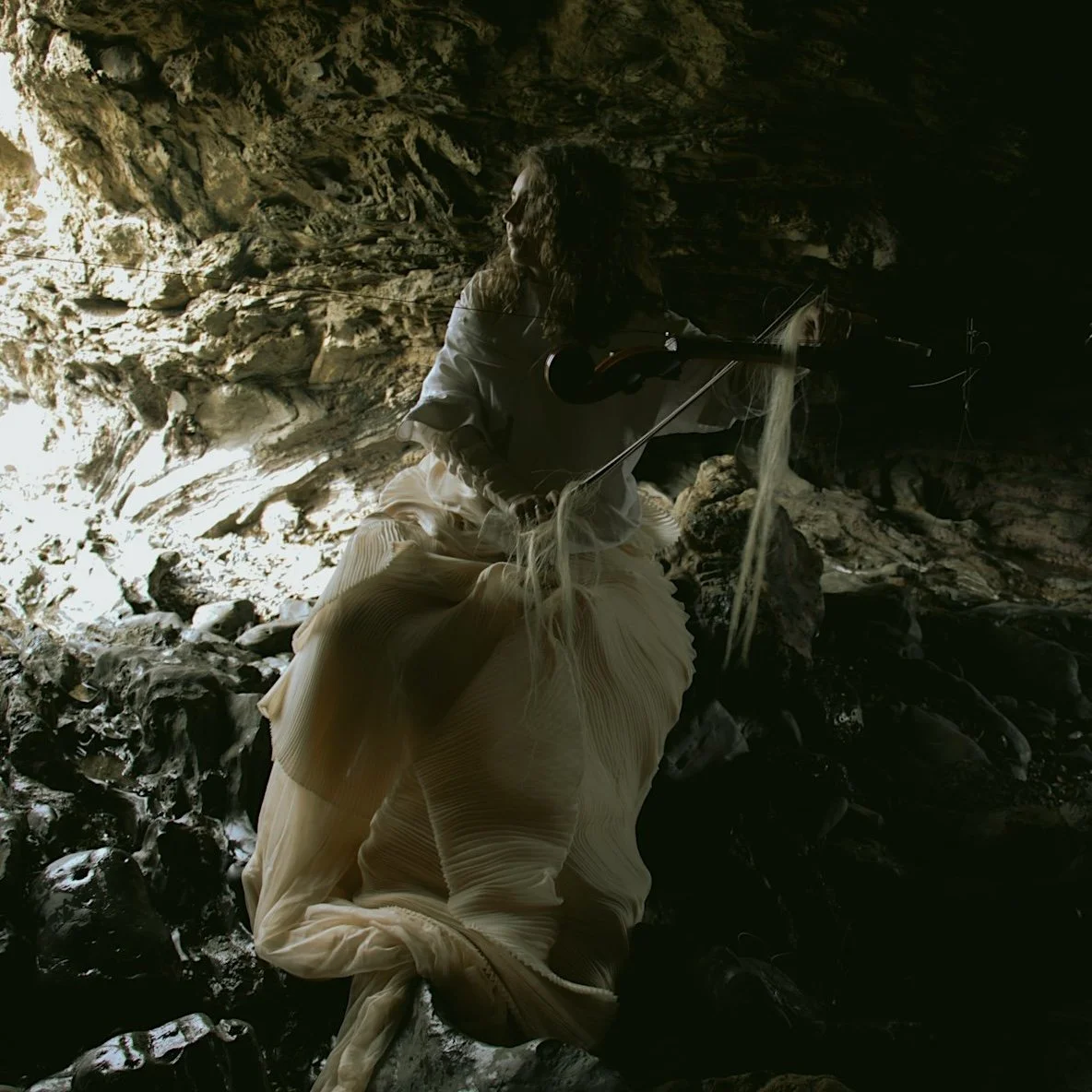
Julia Edith Rigby is an experimental composer and sound artist who thinks about our wild and resonating worlds—the world we inhabit now, and worlds that have come and gone. She is curious about lithic listening and lithic histories, the stories of rocks that have witnessed our collective past and the forces that shaped our planet. She researches ecological entanglements and sense of place, more-than-human architectures and timescales, climate memory and geological listening, planetary histories and resonance, sensory worlds and sense of time. Rigby improvises with pipe organ, prepared piano, viola, stones, infrasound, scientific instrumentation, field recordings, live electronics and moving imagery to take us on a deep dive into deep time and explore questions like: what stories can we learn from the rocks that exist—as they have for millennia--beneath the places we gather? How can listening to rocks help us better understand—and reimagine—the stories of our planet?
What can we collectively learn about our rapidly changing world—and our relationships with other living things, and with ourselves--by finding new ways to think about listening?
And how can listening help us imagine new futures in times of uncertainty?
Julia Edith Rigby (Santa Ana, CA) has performed at 316Centro in CDMX (2025), The Chapel in Seattle (2025), Heidi Duckler Dance in Los Angeles (2024), LEAF Festival in Lafayette, Colorado (2024), LOW End at the Bemis Center for Contemporary Arts in Omaha, Nebraska (2023), the Toulouse Theater in New Orleans (2023), Sappyfest in New Brunswick (2024) and the Atlantic Center for the Arts in New Smyrna, Florida (2023). Her work has been featured twice on Bandcamp’s Best Field Recordings. She is a recipient of artist grants from the LA County Department of Arts and Culture, Arts New Brunswick, the Center for Cultural Innovation and the U.S. Department of State’s Bureau of Educational and Cultural Affairs. Rigby was the Sound Art + Experimental Music Fellow at the Bemis Center for Contemporary Arts in Omaha, Nebraska in fall 2023. She has been an artist in residence at the Sitka Center for Art and Ecology, PLAYA Summer Lake, Anderson Ranch Arts Center, GlogauAIR and others.