
Infinity in a Box:
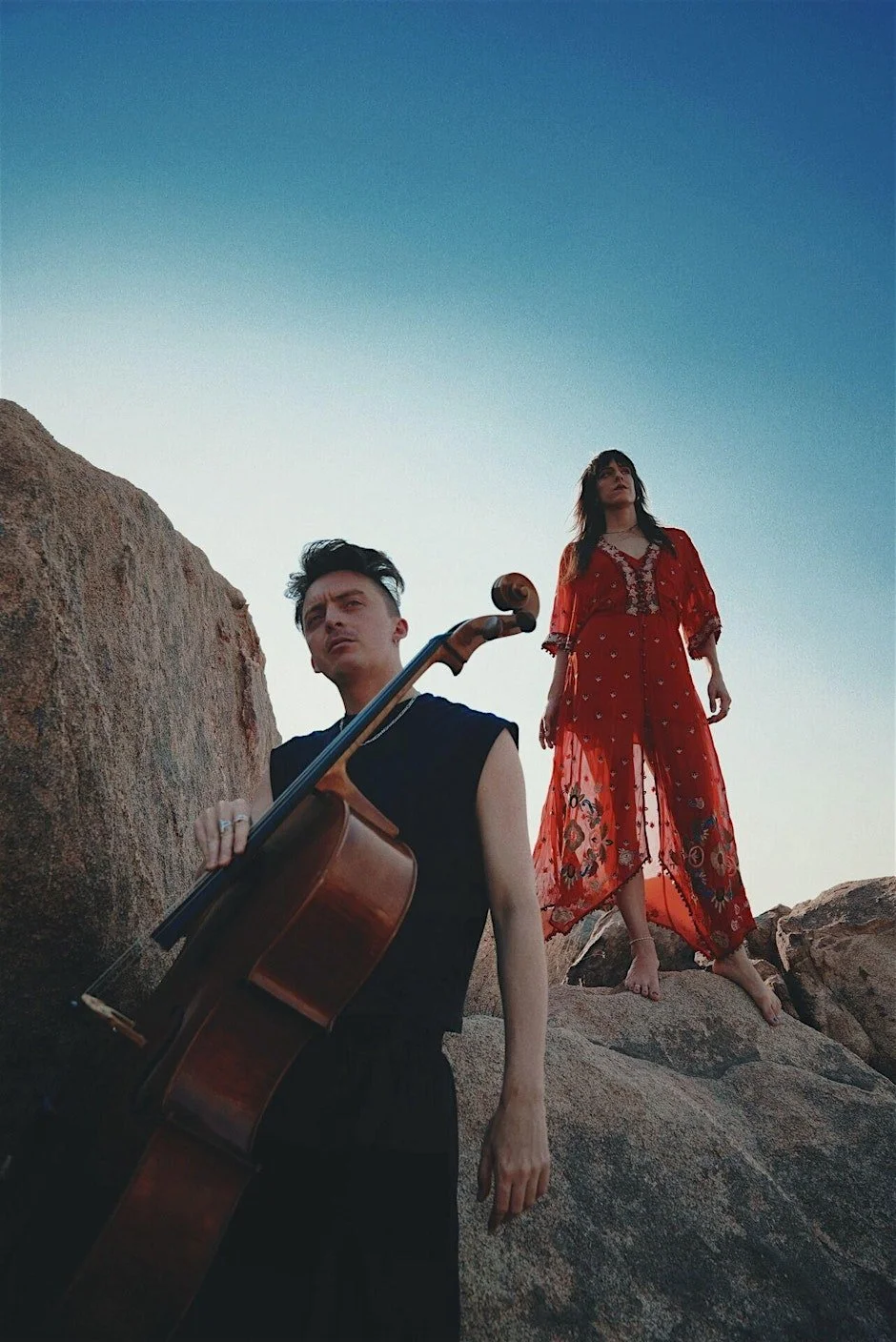
EMÆL+Meadowmaker
First Congregational Church of Los Angeles
540 South Commonwealth Avenue Los Angeles, CA 90020
Sunday November 23rd, 2025
Avant-garde chamber pop collaborators EMÆL and Meadowmaker offer an introspective concert exploring the infinite.
-
There is a principle found across cultures that the universe is made of two opposing forces, the interaction of which are the energetic cause of creation and creativity. The duality is set up in a number of ways: order and chaos, good and evil, passivity and activity, and any number of opposites that ebb and flow against one another with a generative tension. Examples of this include the Rwa Bhineda in Balinese Hinduism, Zoroastrianism’s conflict between good and evil, and the Yin-Yang principle of Toaist philosophy.
One Western version of this duality was popularized by the philosopher Friedrich Nietzsche in his book The Birth of Tragedy... Nietzsche suggests that we find our highest and most meaningful art in a synthesis of two opposing energies he borrows from Greek mythology: the Apollonian and Dionysian.
On one hand, we have Apollo, the god of reason and logic, a force that represents structure, order, and form. On the other we have Dionysus, the god of intoxication, passion, chaos, and raw primal energy. In this duality, the Apollonian is the realm of the mind, analogous to the concept of platonic ideals. The Apollonian is perfect form and structure, crystalline, detached, and static. The Dionysian is formless, a raging river of energy, ever-changing and totally incomprehensible.
This is the classic mystical interpretation of these two energies, that the birth of creativity comes from embracing both sides of this duality, channeling and shaping the unbridled oceanic expanse of the Dionysian into an Apollonian container we can experience and comprehend. Without such a container, we would be overwhelmed – annihilated – by the infinite power of the primeval source. Without that Dionysian energy, the form and structure of the container would be meaningless, without substance.
There is a Sufi parable from the poet Rumi that illustrates this idea:
Muhammad, in the presence of Gabriel, asks,
"Friend, let me see you as you really are. Let me look
as an interested observer looks at his interest."
"You could not endure it. The sense of sight
is too weak to take in this reality."
"But show yourself anyway,
that I can understand what may not be known
with the senses."
The Angel Gabriel unfurled
just a little of the awesome majesty
by which a mountain could be crumbled to dust.
A single royal wing of his covered both east and west.
Muhammad stared, senseless.
When Gabriel saw that senselessness,
how in astonishment his senses flew away,
he came and drew him into his arms.
That awe is the portion of strangers,
but this gentle affection comes to embrace a friend.1
Here, the Dionysian comes from the infinite expanse of the spiritual world, too vast and incomprehensible for the mortal mind to comprehend without a filter, the Apollonian, to shape and contain it. In this interpretation, it is the physical world that is the limiter, letting us experience the infinite in a way we can understand.
Or as William Blake wrote:
To see a world in a grain of sand
And a heaven in a wild flower,
Hold infinity in the palm of your hand
And eternity in an hour.
Or said another way, capturing infinity in a box.
But Nietzsche turns the nature of these two energies on its head. Rather than a duality of the spiritual (Dionsyian/Infinite) world and the physical (Apollonian/contained) world, Nietzsche says that the raw primal Dionysian energy comes from the physical world, from the earth itself. It is the material that is irrational and chaotic, full of a generative life force, and it is the rational mind that shapes it into the comprehensible.
Nietzsche’s criticism of art is that we’ve focused too much on abstraction, concept, and structure rendering our creative output hollow and meaningless. He warns us against a disembodied art that puts value on spiritual ideals too distanced from the messy, violent struggle of living. By dismissing the complex, irrational physicality of the material world in favor of theory and form we lose something vital and life-affirming, the immediacy of the present moment, the rawness of the now.
In Nietzsche’s view we side-step the question at the heart of a spiritual paradox: How can a cup contain the ocean? Perhaps this is what Emily Dickinson meant when she wrote, "Eternity is composed of Nows." This is the nature of presence and the body’s relationship to it. Any fraction of the unending is as large as the original whole.
It’s not just art that balances these energies, it’s also in our being to contain this dual nature. Perhaps we are not just the conduit for external energies, but the work of art as well. Not just the work of art, but the generative force itself. Creator and created, the channeler and that which has been channeled. That’s the miracle of our physical nature and our creative spark; the internal mystery is an impossible math, thumbing its nose at physics and gleefully dancing about with no concern for how this vessel so easily holds the infinite.
Performers

EMÆL and Meadowmaker
Known for their introspective and transporting soundscapes, the avant-garde chamber pop collaborators EMÆL and Meadowmaker bring together a mixed ensemble of cello, voice, guitar, and percussion with live electronics in a concert that explores the Dionysian well of creativity and how we channel and give it shape through the Apollonian structures of art. This concert searches for the infinite that hides within the finite, in both endless divisible and endless creativity, using song to uncover the unknown mystery within and around us.